Defective Aqueduct Pipe Section
Earth AbidesThe Defective Aqueduct Pipe Section is the small, compromised length of steel whose eventual rupture interrupts the flow of mountain water to the cities. First overlooked during manufacture and later left unrepaired after a leak appeared, it deteriorates over years until the ground beneath its support gives way and the pipe splits. Its failure turns an inconspicuous defect into a crisis for the reservoirs, illustrating how a vast public system can depend on one neglected joint in its network.
A flaw hidden inside the water system
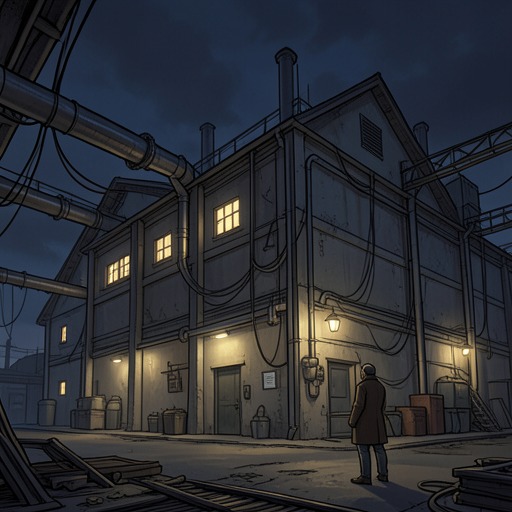
The pipe section lay in the main aqueduct, part of an immense system of dams, tunnels, aqueducts, and reservoirs that carried water from the mountains to the cities. Its defect began before the catastrophe: imperfections had been visible during manufacture, but the section passed inspection at the end of a workday, when the inspector’s senses were dulled and judgment impaired. The pipe was installed nonetheless and initially functioned without difficulty. The defect was therefore not an obvious break that stopped the system at once, but a weakness concealed within infrastructure that appeared to work.
Shortly before the Great Disaster, a foreman noticed a slight leak. A welded patch could have made the section as good as new, or even stronger than average. That repair did not resolve its future, however. In the years that followed, no one passed that way again. The pipe remained part of a functioning network in name, but the inspection and maintenance that might have corrected its weakness had disappeared.
A leak becomes a landscape
The first signs of the failure were modest. Water trickled from the defective section, leaving a green patch beside the pipe even during dry summers. Birds and small animals came to drink there. The water that escaped was already being lost to the aqueduct’s purpose, yet at ground level it seemed to sustain a small pocket of life.
Over five and then ten years, rust ate into the steel from the outside while the water’s corrosive action worked from within. Pinprick holes formed in the pipe’s tough skin. By about a dozen years, a dozen fine jets of spray played from its surface, and the puddle below had become a drinking place for cattle. Five years later, the leak had grown into a little stream, the only summer stream in that dry foothill region. Meanwhile the pipe had become honeycombed with rust, its structure weakened. The sequence is gradual enough to be measured in years, but each change marks both a worsening failure and a widening dependence on water escaping from the system.
Collapse of the support and rupture of the pipe
The prolonged leak softened and muddied the ground beneath the pipe. Animals tramping there helped erode a small gully. Eventually the erosion triggered a mudflow in the soft, wet soil supporting the concrete pier that carried the pipe and its heavy load of water. As the pier settled, the water’s weight shifted onto the rust-weakened steel. A long rent opened, and a broad stream poured into the gully.
That first rupture did not end the process. The torrent undermined the pier’s footing further; the support shifted again, the pipe tore again, and the flow grew to the scale of a small river. The failure is thus not simply a corroded object breaking. Water escaping from the pipe alters the ground, the altered ground weakens the support, and the support’s movement places still greater strain on the damaged steel. Each consequence accelerates the next until a minor leak becomes a major breach.
The network’s hidden dependence on maintenance
For several weeks, water gushed from the broken aqueduct pipe like a small river, and none flowed onward into the reservoirs. At the same time, stored water drained away through thousands of leaks accumulated over the years, faucets left running at the Great Disaster, and major breaks caused by the earthquake. Heavy rains in the week after New Year slowed the reservoir’s decline, but the midwinter dry spell arrived earlier than usual. Where the gauge had recently shown twenty feet, only a thin skin of water covered the bottom. The pipe did not account for every loss, but its rupture cut off the incoming supply while other failures depleted what had already been stored.
The book places this slow water-system collapse beside other evidence of how human infrastructure depends on continual care. Power-and-Light continues operating after the disaster because its system adjusts automatically at first, but its generators ultimately fail when their governors, which require regular oil inspection and replenishment, go unattended. On San Lupo Drive, a drain plugged with unswept leaves and rainwater crossed the street, flooded a house, and cut a small gully through a former lawn. These are distinct failures, not consequences of the aqueduct breach; together they reveal the same dependence on ordinary maintenance. The defective section makes that dependence especially legible because its tiny leak persists for years before the support fails. Once routine repair is absent, a defect that once could have been patched becomes a physical process beyond any single repair: water, rust, soil, erosion, and weight combine to break the system that had carried water to the cities.